
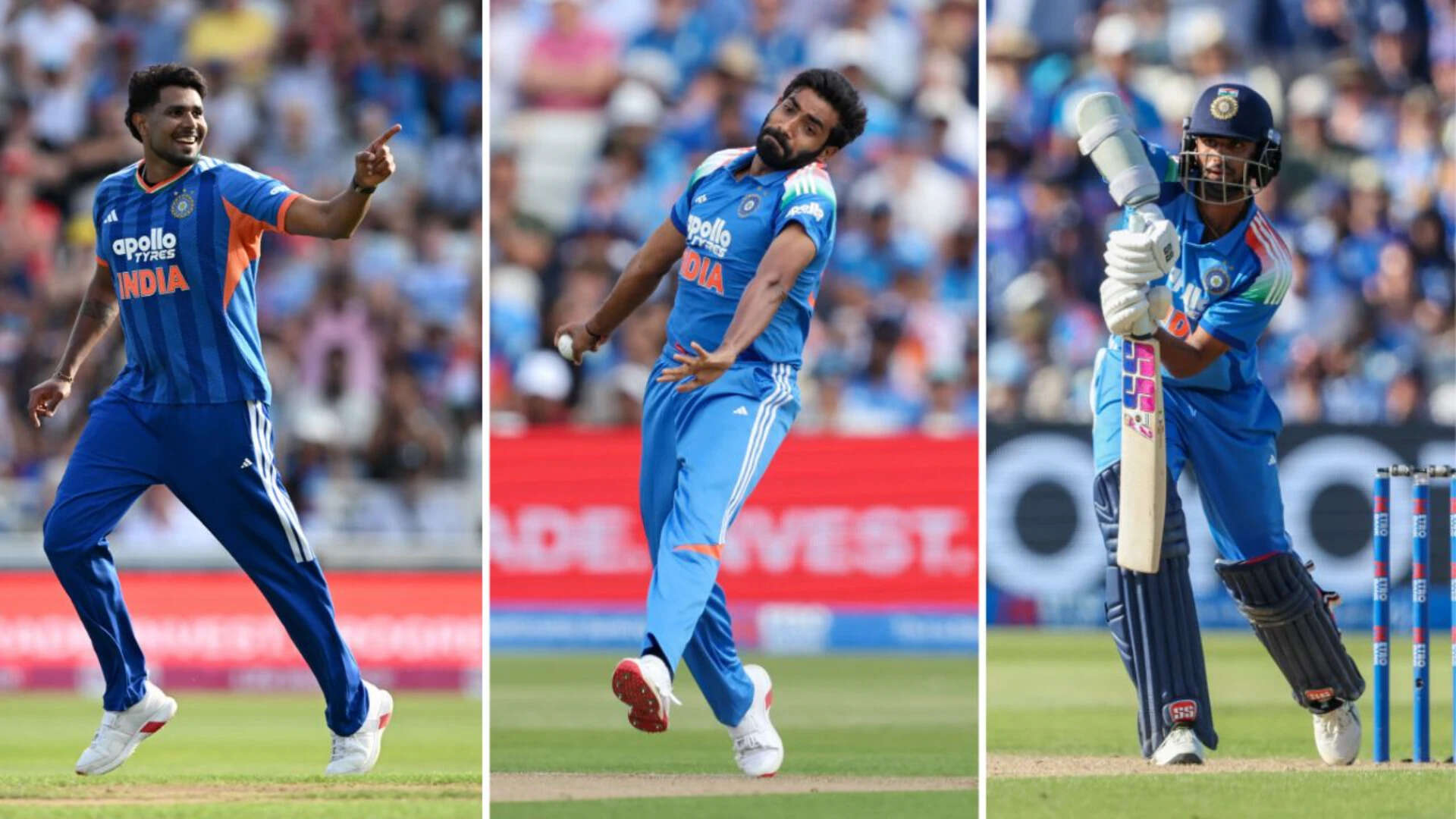
India’s preparation for the 2027 ODI World Cup is not just about identifying the right combinations, building batting depth, or managing workloads. Increasingly, it is becoming about something far more basic: keeping key players fit long enough to build a settled squad.
With the tournament cycle already underway, India’s injury list is becoming a serious concern. Nitish Kumar Reddy injured himself during the ODI series against Afghanistan last month. Hardik Pandya has not played an ODI for India since the Champions Trophy final against New Zealand in March 2025. Harshit Rana has suffered two injury setbacks in the last six months. Washington Sundar has had multiple breakdowns in the same period. Varun Chakravarthy, too, has been hit by a hairline fracture followed by a Grade 2 hamstring injury.
Individually, these may appear like routine setbacks in a packed cricket calendar. Collectively, they point to a larger issue: India’s World Cup planning is being repeatedly interrupted by fitness uncertainty.
All-rounders remain India’s biggest concern
The biggest headache for India is the lack of continuity among all-round options. In ODI cricket, balance is everything. A proper all-rounder allows a team to play an extra batter, an extra bowler, or create tactical flexibility depending on conditions.
That is why Hardik Pandya’s absence from ODIs since March 2025 is so significant. When fit, Hardik gives India a rare package: middle-order hitting, seam-bowling overs, fielding quality, and leadership presence. But the longer he stays away from the 50-over format, the harder it becomes for India to plan around him with certainty.
Nitish Kumar Reddy was being viewed as one of the players who could potentially ease that burden. His ability to contribute with both bat and ball made him an exciting option in India’s long-term ODI thinking. However, his injury during the Afghanistan series is another reminder that talent alone is not enough. Durability will be just as important in the road to 2027.
Washington Sundar’s stop-start run hurts squad balance
Washington Sundar’s repeated breakdowns are another major setback. A finger-spinner who can bat in the lower middle order is extremely valuable in ODI cricket, especially in conditions where control through the middle overs is crucial.
India need players like Washington to create flexibility. He can support the frontline spinners, bat at No. 7 or No. 8, and offer a match-up option against left-handers. But his inability to string together a long injury-free run makes selection planning difficult.
For the selectors and team management, the question becomes complicated: do they keep investing in a high-value but injury-prone player, or do they move toward more robust alternatives who may not offer the same ceiling?
Fast-bowling depth is being tested early
India have built impressive fast-bowling depth over the last few years, but injuries to emerging pacers like Harshit Rana show how fragile that depth can be. Rana’s two setbacks in six months have disrupted his momentum at a time when he should have been pushing for a more regular role in the ODI setup.
The 2027 World Cup will be played in South Africa, Zimbabwe, and Namibia, where pace, bounce, and hard lengths are expected to matter. India cannot afford to arrive at that tournament with uncertainty around their seam-bowling reserves.
The likes of Jasprit Bumrah, Mohammed Siraj, Arshdeep Singh, Prasidh Krishna, Avesh Khan, Mukesh Kumar, and others may remain in the discussion, but the management needs a wider pool. Injuries to players like Rana reduce the opportunity to test combinations in real match conditions.
Varun Chakravarthy’s injuries weaken the mystery-spin option
Varun Chakravarthy has had a particularly frustrating period. A hairline fracture followed by a Grade 2 hamstring injury has kept him away from action at a crucial stage.
In white-ball cricket, Varun brings a skill set that is not easy to replicate. His variations, pace changes, and ability to attack batters through the middle overs make him a different kind of option compared to conventional spinners.
But ODI cricket demands more than short bursts. Bowlers need to handle ten-over workloads, field for 50 overs, recover quickly, and repeat the process across a series or tournament. Varun’s recent injury pattern raises questions over whether he can be consistently available for that role in a long World Cup campaign.
Injuries are damaging role clarity
The biggest impact of these injuries is not just the absence of players from individual matches. It is the damage done to role clarity.
World Cup-winning teams usually know their core well in advance. They know who bats where, who bowls in which phase, who finishes games, who controls the middle overs, and who provides backup if a first-choice player is unavailable.
For India, constant injury breaks make that process unstable. A player comes in, shows promise, gets injured, returns after a gap, and has to restart the audition. Meanwhile, another player gets a chance, but the team cannot fully commit because the first player is still part of the long-term plan.
This creates a cycle of uncertainty. By the time the World Cup approaches, India may have plenty of options but not enough settled answers.
Workload management must become more precise
India’s calendar is demanding, with international cricket, IPL commitments, travel, training loads, and format changes all adding pressure on players’ bodies. General workload management is no longer enough. India need more individualised fitness planning.
Players like Hardik Pandya and Washington Sundar cannot be managed the same way as specialist batters. Fast bowlers like Harshit Rana require different monitoring from spinners like Varun Chakravarthy. Younger all-rounders such as Nitish Kumar Reddy need careful workload progression rather than sudden exposure to intense multi-format demands.
The National Cricket Academy, selectors, team management, and IPL franchises will need to work in greater coordination. If India want their best players available in 2027, the planning has to start now.
The 2027 World Cup challenge
The conditions in southern Africa will demand a physically strong squad. Batters will need to handle bounce and pace. Bowlers will need stamina across long spells. Fielding standards will be non-negotiable on bigger grounds. All-rounders will be vital because team balance could change depending on venues.
That makes India’s current injury trend even more worrying. A World Cup in these conditions cannot be approached with half-fit players or uncertain workloads. The squad must be athletic, durable, and tactically settled.
India need availability as much as ability
India are not short of talent. The pipeline remains rich, and there are multiple players competing for every role. But as the 2027 ODI World Cup cycle gathers pace, the key word is no longer just talent. It is availability.
Hardik Pandya’s ODI absence, Nitish Kumar Reddy’s untimely injury, Harshit Rana’s repeated setbacks, Washington Sundar’s stop-start fitness record, and Varun Chakravarthy’s recent breakdowns all point to the same concern: India’s planning is being forced to adjust too often.
If this pattern continues, India may reach 2027 with a talented squad but without the continuity required to win a global tournament. The next phase must be about building a core that not only performs but also stays on the park.
Because World Cups are not won by the best names on paper. They are won by the best combinations that are fit, settled, and battle-ready when it matters most.