
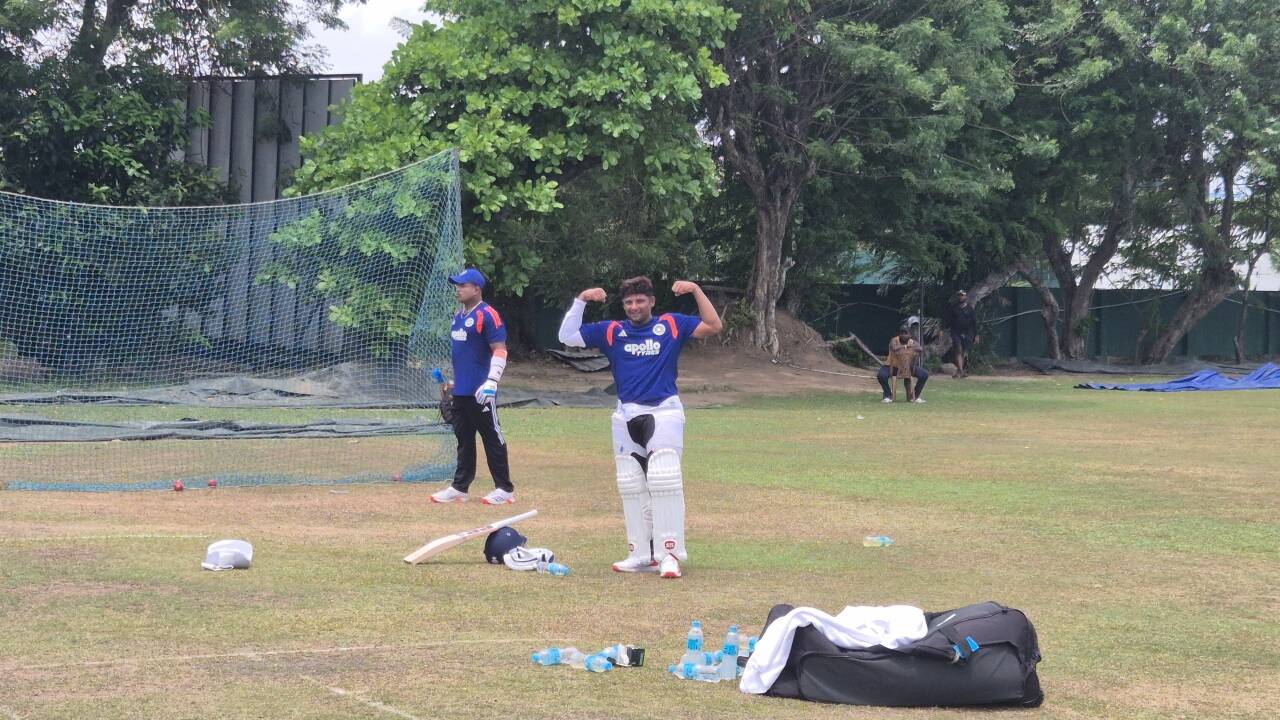
Trial by Spin with a Hint of Reverse: Inside India’s Final Net Session in Colombo
The humid air of Colombo carried more than just the scent of rain as India’s Test squad gathered for their final net session ahead of the two-match series against Sri Lanka. With the series opener looming on August 15, the Indian camp left no stone unturned in their preparations—especially with the pitch at the R. Premadasa Stadium expected to behave like a Day 4 minefield: dry, cracked, and unforgiving.
A Late Change and Fresh Energy
In a last-minute shuffle, Sarfaraz Khan stepped in as a replacement for Sai Sudharsan, adding a dynamic presence to India’s middle order. Known for his nimble footwork and ability to tackle spin, Sarfaraz’s inclusion hinted at India’s strategic focus on countering Sri Lanka’s spin-heavy attack. His arrival injected fresh energy into the nets, where he was seen working closely with the team’s throwdown specialists, honing his technique against both off-spin and leg-spin.
Pitch Simulation: Preparing for the Worst
The Indian team didn’t just practice—they simulated battle conditions. The nets were set up to mimic the deteriorating Colombo pitch, with coaches deliberately roughing up the surface to replicate the cracks and variable bounce expected in the actual match. Spinners like Ravichandran Ashwin and Kuldeep Yadav were given the task of exploiting these conditions, while the batters—led by captain Shubman Gill—faced a relentless barrage of turn and bounce.
Gill, in particular, was seen spending extra time in the nets, working on his footwork against spin and fine-tuning his ability to play the reverse sweep—a shot that could be crucial on a turning track. “It’s all about teamwork,” Gill remarked after the session. “We’re not just preparing for the first day; we’re preparing for the fourth and fifth days, where the real test begins.”
The Reverse Sweep: India’s Secret Weapon?
One of the most intriguing aspects of India’s net session was the emphasis on unconventional shots, particularly the reverse sweep. With Sri Lanka’s spinners likely to dominate proceedings, India’s batters seemed to be adding this high-risk, high-reward shot to their arsenal. Players like Rishabh Pant and Shreyas Iyer were seen practicing the shot repeatedly, using it to disrupt the spinners’ lengths and create scoring opportunities.
“The reverse sweep isn’t just about scoring runs—it’s about dictating terms,” said a team insider. “If the spinners know you can hit them over the slip cordon or behind square, they’ll think twice before bowling that extra flighted delivery.”
Bowlers’ Workload: Ashwin’s Masterclass
While the batters sweated it out, India’s spinners were also put through their paces. Ravichandran Ashwin, the seasoned campaigner, took charge of the session, offering tactical insights to the younger bowlers. His ability to read the pitch and adjust his lengths accordingly was on full display, as he mixed carrom balls with traditional off-spin to keep the batters guessing.
“Ashwin is like a chess grandmaster,” joked one of the support staff. “He doesn’t just bowl—he plans three deliveries ahead.”
The Road Ahead: A Test of Adaptability
As India wraps up their final preparations, the focus remains on adaptability. The Colombo pitch, with its uneven bounce and sharp turn, will test every aspect of India’s game—from their batting technique to their bowling discipline. With the series opener just days away, the team’s ability to adjust on the fly could be the difference between victory and defeat.
One thing is certain: India’s net session wasn’t just about practice—it was a trial by spin, with a hint of reverse. And if their preparations are anything to go by, they’re ready to turn the tables in Sri Lanka.
Will India’s gamble on unconventional shots pay off? Or will Sri Lanka’s spinners weave their magic? The answer lies in the Colombo dust.